New BG Letter: A novel laser-based spectroscopic method reveals the isotopic signatures of nitrous oxide produced by eukaryotic and prokaryotic phototrophs in darkness
20 January 2026
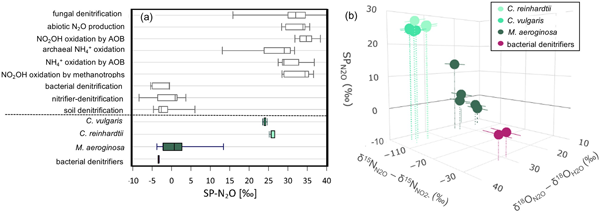
The authors present a new method for the accurate laser-based analysis of N2O isotopes. For the first time, they measured the Site Preference-N2O signatures of pure cultures of microalgae and cyanobacteria. Their study is a first step to ultimately develop process-specific N2O monitoring from aquatic ecosystems. Further research is now needed to determine the occurrence and significance of N2O emissions from microalgae and cyanobacteria from aquatic ecosystems.
Co-editor-in-chief's statement: In aquatic ecosystems, the production of nitrous oxide (N2O), an important greenhouse gas, was until recently mostly ascribed to the activity of nitrifiers and denitrifiers. Recent research has revealed that a range of other organisms are also capable of producing N2O, but quantifying their contribution has remained challenging. Plouviez et al. present a novel approach based on the stable nitrogen and oxygen isotope composition of N2O, combined with the intramolecular distribution of 15N ("site preference"). They found that various microalgae grown in darkness present distinct stable isotope patterns, which paves the way for improving our ability to distinguish the contribution of different microbial groups to N2O production in aquatic ecosystems.
Please also read the press release by Cawthron Institute.
Contact: Naomi Wells (naomi.wells@lincoln.ac.nz)