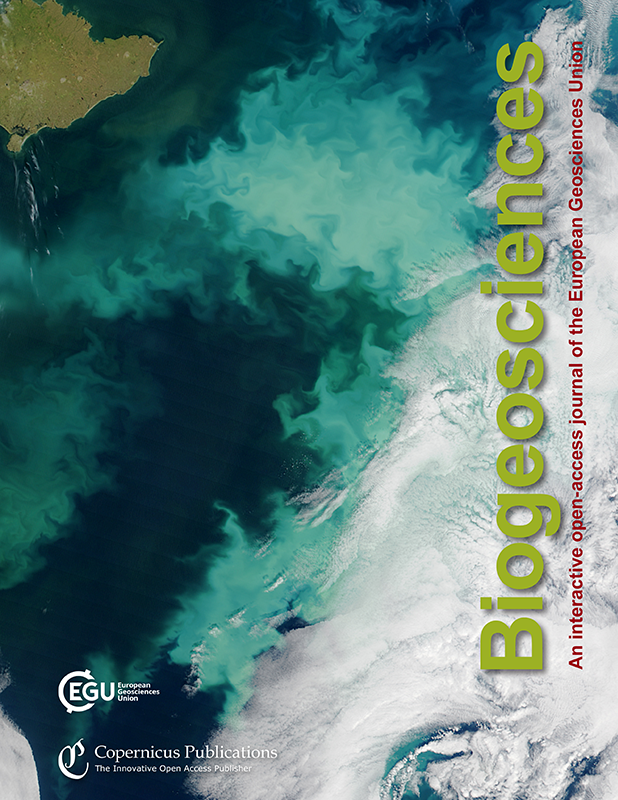
BG cover
Co-editors-in-chief: Steven Bouillon, Carolin Löscher, Sebastian Naeher, Anja Rammig, Paul Stoy, Tina Treude & Sara Vicca
eISSN: BG 1726-4189, BGD 1810-6285

Biogeosciences (BG) is a not-for-profit international scientific journal dedicated to the publication and discussion of research articles, short communications, and review papers on all aspects of the interactions between the biological, chemical, and physical processes in terrestrial or extraterrestrial life with the geosphere, hydrosphere, and atmosphere. The objective of the journal is to cut across the boundaries of established sciences and achieve an interdisciplinary view of these interactions. Experimental, conceptual, and modelling approaches are welcome.

Journal metrics

BG is indexed in the Web of Science, Scopus, Google Scholar, etc. We refrain from displaying the journal metrics prominently on the landing page since citation metrics used in isolation do not describe importance, impact, or quality of a journal. However, these metrics can be found on the journal metrics page.

Recent papers

05 Dec 2025
| Highlight paper
The influence of irradiance and interspecific differences on δ11B, δ13C and elemental ratios in four coralline algae complexes from Aotearoa, New Zealand
Maxence Guillermic, Erik C. Krieger, Joyce Goh, Christopher E. Cornwall, and Robert A. Eagle
Biogeosciences, 22, 7669–7686, https://doi.org/10.5194/bg-22-7669-2025,https://doi.org/10.5194/bg-22-7669-2025, 2025
Short summary Co-editor-in-chief
05 Dec 2025
Investigating relationships between nitrogen inputs and in-stream nitrogen concentrations and exports across catchments in Victoria, Australia
Olaleye Babatunde, Meenakshi Arora, Siva Naga Venkat Nara, Danlu Guo, Ian Cartwright, and Andrew W. Western
Biogeosciences, 22, 7647–7668, https://doi.org/10.5194/bg-22-7647-2025,https://doi.org/10.5194/bg-22-7647-2025, 2025
Short summary
05 Dec 2025
Seasonal dynamics of vegetation effect on peatland surface energy balance
Vincent E. Flemming, Nicolas Behrens, and Mana Gharun
EGUsphere, https://doi.org/10.5194/egusphere-2025-5633,https://doi.org/10.5194/egusphere-2025-5633, 2025
Preprint under review for BG (discussion: open, 0 comments)
Short summary
05 Dec 2025
Worms or storms? Distinguishing bioturbation from physical mixing using multiple tracers
Tjitske J. Kooistra, Anna-Maartje de Boer, Tjeerd J. Bouma, Natascia Pannozzo, Stuart G. Pearson, Ad van der Spek, Henko de Stigter, Jakob Wallinga, Rob Witbaard, and Karline Soetaert
EGUsphere, https://doi.org/10.5194/egusphere-2025-6029,https://doi.org/10.5194/egusphere-2025-6029, 2025
Preprint under review for BG (discussion: open, 0 comments)
Short summary
04 Dec 2025
Multi-source remote sensing for large-scale biomass estimation in Mediterranean olive orchards using GEDI LiDAR and machine learning
Francisco Contreras, María L. Cayuela, Miguel A. Sánchez-Monedero, and Pedro Pérez-Cutillas
Biogeosciences, 22, 7625–7646, https://doi.org/10.5194/bg-22-7625-2025,https://doi.org/10.5194/bg-22-7625-2025, 2025
Short summary

Highlight articles

05 Dec 2025
The influence of irradiance and interspecific differences on δ11B, δ13C and elemental ratios in four coralline algae complexes from Aotearoa, New Zealand
Maxence Guillermic, Erik C. Krieger, Joyce Goh, Christopher E. Cornwall, and Robert A. Eagle
Biogeosciences, 22, 7669–7686, https://doi.org/10.5194/bg-22-7669-2025,https://doi.org/10.5194/bg-22-7669-2025, 2025
Short summary Co-editor-in-chief
25 Nov 2025
Including different mesozooplankton feeding strategies in a biogeochemical ocean model impacts global ocean biomass and carbon cycle
Lisa Di Matteo, Fabio Benedetti, Sakina-Dorothée Ayata, and Olivier Aumont
Biogeosciences, 22, 7233–7268, https://doi.org/10.5194/bg-22-7233-2025,https://doi.org/10.5194/bg-22-7233-2025, 2025
Short summary Co-editor-in-chief
20 Nov 2025
Novel oxalate-carbonate pathways identified in the tropical dry evergreen forest of Tamil Nadu, India
Camille Rieder, Eric P. Verrecchia, Saskia Bindschedler, Guillaume Cailleau, Aviram Rozin, Munisamy Anbarashan, Shubhendu Dasgupta, Thomas Junier, Nicolas Roeschli, Pascal Vittoz, and Mike C. Rowley
Biogeosciences, 22, 6979–6999, https://doi.org/10.5194/bg-22-6979-2025,https://doi.org/10.5194/bg-22-6979-2025, 2025
Short summary Co-editor-in-chief
12 Nov 2025
Reviews and syntheses: Artisanal and small-scale gold mining (ASGM)-derived mercury contamination in agricultural systems: what we know and need to know
David S. McLagan, Excellent O. Eboigbe, and Rachel J. Strickman
Biogeosciences, 22, 6695–6726, https://doi.org/10.5194/bg-22-6695-2025,https://doi.org/10.5194/bg-22-6695-2025, 2025
Short summary Co-editor-in-chief
06 Nov 2025
Automated mask generation in citizen science smartphone photos and their value for mapping plant species in drone imagery
Salim Soltani, Lauren E. Gillespie, Moises Exposito-Alonso, Olga Ferlian, Nico Eisenhauer, Hannes Feilhauer, and Teja Kattenborn
Biogeosciences, 22, 6545–6561, https://doi.org/10.5194/bg-22-6545-2025,https://doi.org/10.5194/bg-22-6545-2025, 2025
Short summary Co-editor-in-chief

Scheduled special issues

01 Oct 2025–30 Apr 2026 | Ewa Poniecka (University of Warsaw, Poland), Roberto Ambrosini (University of Milan, Italy), Helge Niemann (Royal Netherlands Institute for Sea Research, The Netherlands), and Tina Šantl-Temkiv (Aarhus University, Denmark) | Information
01 Oct 2024–31 Dec 2025 | Sanja Frka (Rudjer Boskovic Institute, Croatia), Peter S. Liss (University of East Anglia, United Kingdom), Klaus Jürgens (Leibniz Institute for Baltic Sea Research, Germany), Frédéric Gazeau (Laboratoire d’Océanographie de Villefranche, France), and Hermann Bange (GEOMAR Helmholtz Centre for Ocean Research Kiel, Germany) | Information
10 Nov 2023–indefinite | David McLagan (Queen's University, Canada), Ashu Dastoor (Environment and Climate Change Canada, Canada), Johannes Bieser (Helmholtz-Zentrum Hereon, Germany), Celia Chen (Dartmouth, Department of Biological Sciences, USA), Jane Kirk (Environment and Climate Change Canada, Canada), Adrien Mestrot (Institute of Geography, Switzerland), Anne L. Soerensen (Swedish Museum of Natural History, Sweden), and Xun Wang (Institute of Geochemistry, China) | Information
02 Nov 2023–31 Oct 2026 | Frédéric Gazeau (Villefranche Oceanographic Laboratory, France), Manmohan Sarin (Physical Research Laboratory, India), Suzanne Fietz (Stellenbosch University, South Afrca), Douglas Hamilton (North Carolina State University, USA), Akinori Ito (Japan Agency for Marine-Earth Science and Technology, Japan), Morgane Perron (Laboratoire des Sciences de l'Environnement Marin, France), and Mingjin Tang (Chinese Academy of Sciences, China) | Information
01 Feb 2020–indefinite | Eric Achterberg, Javier Arístegui, Francisco Chavez, Michelle I. Graco, Hans-Peter Grossart, Dimitri Gutierrez, Ulf Riebesell, and Silvio Pantoja | Information

News

03 Dec 2025 New MS Word template available for manuscript preparation

The existing MS Word template for authors has been significantly expanded and now includes many important notes on the standard sections that must be included in the manuscript. Please visit the "Submission" page, section "Templates for your manuscript file" and download the new template before writing your next manuscript.

03 Dec 2025 New MS Word template available for manuscript preparation

The existing MS Word template for authors has been significantly expanded and now includes many important notes on the standard sections that must be included in the manuscript. Please visit the "Submission" page, section "Templates for your manuscript file" and download the new template before writing your next manuscript.

21 Nov 2025 New BG Letter: Evidence for highly variable land use but a stable climate in the southwest Maya lowlands

Over time, traces of humans, fire, and plants accumulate at the bottom of lakes. They reveal the history of how the lowland Maya, a society thought to have declined due to drought, transformed their environment over time. The authors show how forest was cleared, agriculture expanded, and population levels rose then declined. Please read more.

21 Nov 2025 New BG Letter: Evidence for highly variable land use but a stable climate in the southwest Maya lowlands

Over time, traces of humans, fire, and plants accumulate at the bottom of lakes. They reveal the history of how the lowland Maya, a society thought to have declined due to drought, transformed their environment over time. The authors show how forest was cleared, agriculture expanded, and population levels rose then declined. Please read more.

20 Oct 2025 Press Release: Invisible poison – Airborne mercury from gold mining is contaminating African food crops, new study warns

In a recent study published in BG, scientists have confirmed that mercury pollution from artisanal and small-scale gold mining (ASGM) is contaminating food crops not through the soil, as previously believed, but directly from the air. Please read more.

20 Oct 2025 Press Release: Invisible poison – Airborne mercury from gold mining is contaminating African food crops, new study warns

In a recent study published in BG, scientists have confirmed that mercury pollution from artisanal and small-scale gold mining (ASGM) is contaminating food crops not through the soil, as previously believed, but directly from the air. Please read more.

Notice on the current situation in Ukraine

To show our support for Ukraine, all fees for papers from authors (first or corresponding authors) affiliated to Ukrainian institutions are automatically waived, regardless if these papers are co-authored by scientists affiliated to Russian and/or Belarusian institutions. The only exception will be if the corresponding author or first contact (contractual partner of Copernicus) are from a Russian and/or Belarusian institution, in that case the APCs are not waived.

In accordance with current European restrictions, Copernicus Publications does not step into business relations with and issue APC-invoices (articles processing charges) to Russian and Belarusian institutions. The peer-review process and scientific exchange of our journals including preprint posting is not affected. However, these restrictions require that the first contact (contractual partner of Copernicus) has an affiliation and invoice address outside Russia or Belarus.